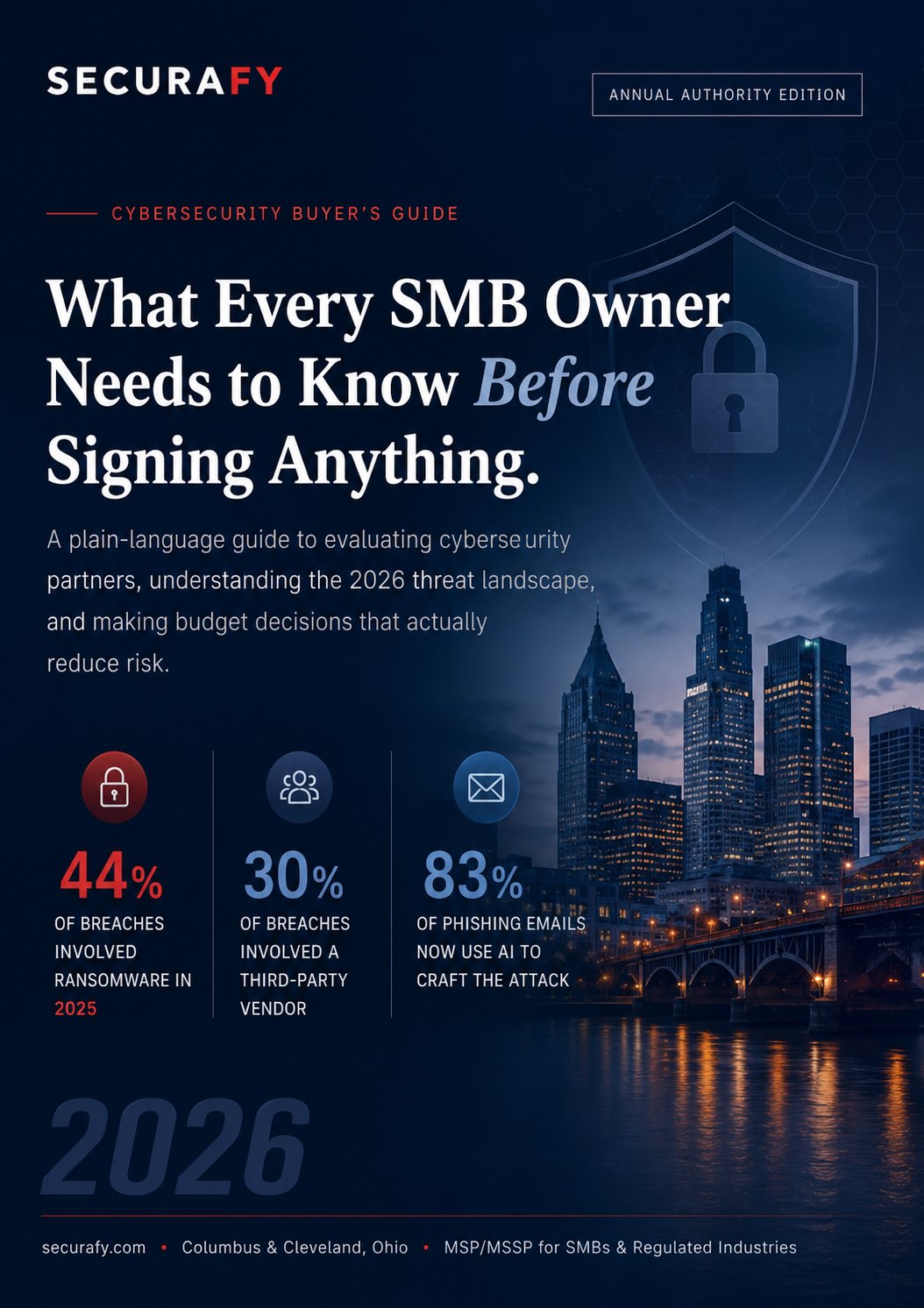
What every SMB owner needs to know before signing anything. A plain-language guide to evaluating cybersecurity partners, understanding the 2026 threat landscape, and making budget decisions that actually reduce risk.
Get the Free Report → Instant access · No credit card · Sources cited throughout
This isn't a product pitch. It's a framework for asking better questions before you sign anything — and for holding whoever manages your security accountable after you do.
What's hitting SMBs right now: credential abuse, ransomware patterns, third-party risk, edge device exploitation, and AI-powered fraud. Verified 2025 data — not theory.
NIST CSF 2.0, CIS Controls v8, SOC 2 Type II. The frameworks every credible provider should map to — and the questions that separate operators from resellers.
How to frame cybersecurity spend as risk management, not IT overhead. Industry benchmarks (6-20% of IT budget) and a four-step expected-loss calculation for leadership.
Eight warning signs that a vendor resells tools but manages nothing. Vague SLAs, no-visibility reporting, reactive-only operations, hidden incident response costs.
Co-managed vs. fully managed MSSP vs. in-house. Six decision dimensions side-by-side, plus the most common mistake SMBs make in co-managed contracts.
The list to bring to every discovery call and RFP. Credentials, coverage, technical capability, transparency — with the reasoning behind every question.
Every question in the checklist has a reason behind it. The categories are organized so you can stress-test a vendor's actual operating model — not just their marketing deck. The full checklist is in the report, with the "why this matters" annotation under each question and a citation to the underlying research.
The full 22-page report — including the complete 20-question checklist with citations, the service model comparison matrix, the CIRCIA compliance section, and red-flag detection criteria — is yours free.
Get the Free Report → 357 KB · PDF · Opens in new tabIt's Securafy's annual research-backed report for SMB owners evaluating cybersecurity partners. The 22-page guide is built on 2025 data from Verizon DBIR, IBM Cost of a Data Breach, Sophos State of Ransomware, NIST, and CISA.
It covers the current threat landscape, what to demand from a security partner, budgeting and ROI, vendor red flags, service model comparison, and includes a 20-question buyer's checklist to bring to every discovery call and RFP.
The guide includes a 20-question checklist organized into four categories:
Credentials and standards — NIST CSF 2.0 alignment, SOC 2 Type II, CIS Controls, team certifications.
Coverage and response — 24/7 analyst review vs. automation, time to first human response, containment authority, incident response inclusion.
Technical capability — ransomware response, immutable backups, MFA enforcement, M365 and cloud security, tool tuning.
Transparency and governance — reporting cadence, cyber insurance support, third-party access management, client references.
Industry benchmarks recommend 6-15% of total IT budget for cybersecurity, scaling by risk profile. Standard SMBs with low digital dependency: 6-10%. Mid-market SMBs with revenue-dependent digital operations: 10-15%. Regulated or data-sensitive industries: 15-20%. The 2024 global enterprise average is 13.2% of IT budget.
The guide frames cybersecurity spend as risk management, not IT overhead, and provides a four-step ROI calculation using expected loss math you can take to leadership.
Per Verizon DBIR 2025: credential abuse drives 22% of breaches, vulnerability exploitation drives 20% (up 34% year-over-year), and ransomware is present in 44% of breaches. Third-party involvement in breaches doubled to 30%.
Edge device exploitation (VPNs, firewalls) grew from 3% to 22% of exploitation targets — an eight-fold increase in two years. AI-powered phishing now accounts for 82.6% of detected phishing emails, up 53.5% year-over-year. AI-enabled fraud surged 1,210% in 2025.
Eight red flags covered in detail in the guide: vague SLAs with no measurable commitments, tool resale disguised as managed security, no client visibility or reporting, no alignment with cyber insurance requirements, reactive-only operations, hidden costs that appear after signing, no independent security credentials like SOC 2 Type II, and weak incident communication standards.
A provider who can't answer coverage and response questions with specifics is the highest-risk hire.
CIRCIA is the Cyber Incident Reporting for Critical Infrastructure Act. CISA's proposed rules will cover approximately 311,000 small entities when they take effect, most likely in 2026.
The rules require mandatory reporting of major cyber incidents within 72 hours and ransom payments within 24 hours. An MSP that cannot support that reporting timeline puts regulated SMBs in regulatory jeopardy on top of operational jeopardy. The guide details what to verify with your provider on incident reporting capability.
Co-managed fits companies with internal IT leadership but limited security depth. High strategic control, moderate vendor dependency.
Fully managed MSSP fits SMBs without enough internal IT or security capacity. 24/7 coverage available, higher vendor dependency.
In-house only fits firms with strong internal IT talent and dedicated security budget. Full control, but 24/7 coverage is difficult at SMB budget and staffing levels.
The most common mistake in co-managed setups is not clearly defining who owns patching, identity, incident response, cloud admin, and executive reporting in writing.
Yes. The guide is published annually by Securafy as a free download. It requires a brief form submission for access — name, email, and company. No credit card, no commitment.
The next edition will be published in 2027 with refreshed data and updated guidance reflecting the current threat landscape.